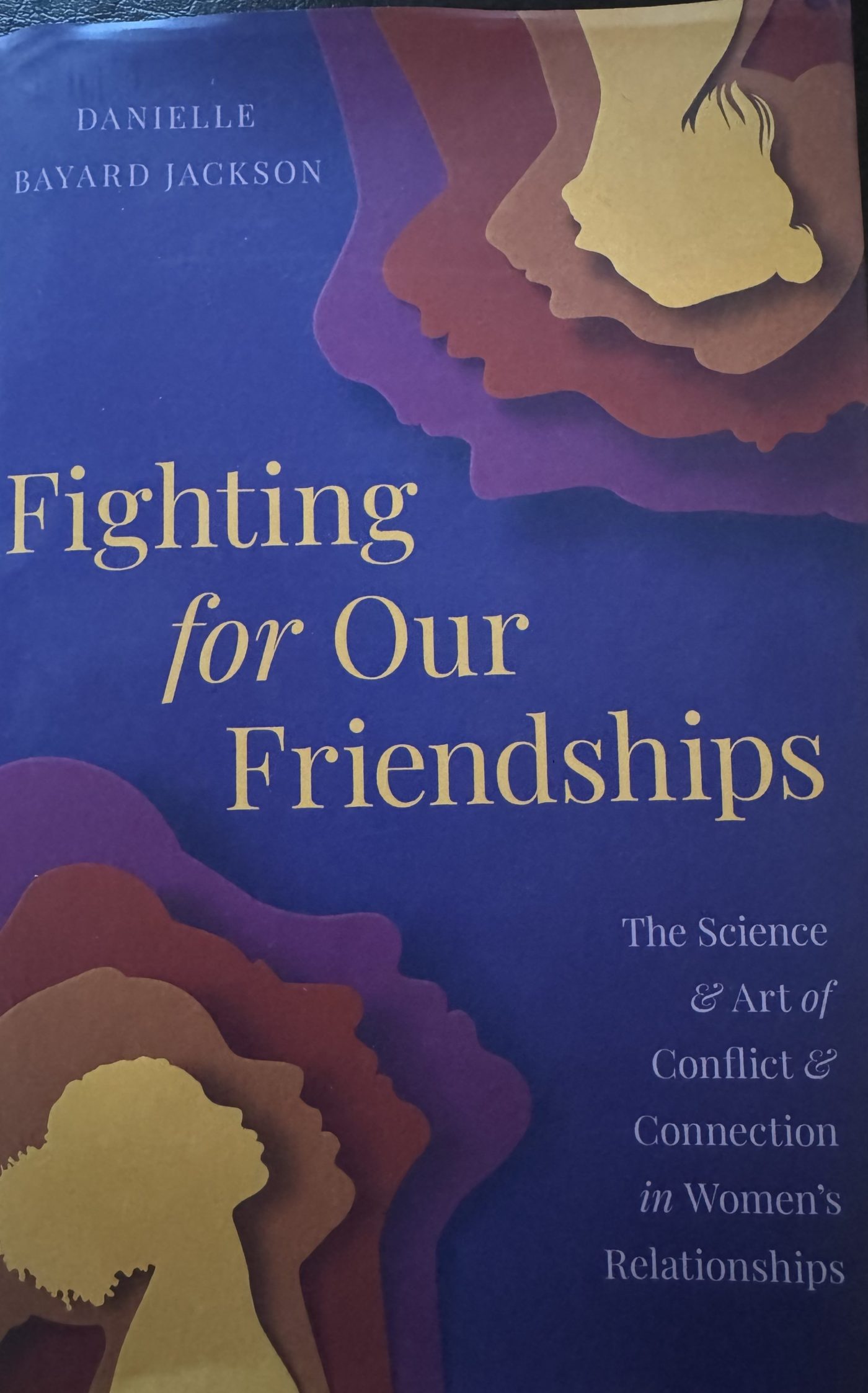
If you’ve ever wondered why female friendships can sometimes feel so messy and complicated when compared to male relationships, you may be interested in reading friendship coach Danielle Bayard Jackson’s new book on the subject entitled Fighting for Our Friendships: The Science and Art of Conflict and Connection in Women’s Relationships.
I became curious about Jackson and her new book after listening to her being interviewed on the Mel Robbins podcast a few weeks ago. Their discussion was fascinating and left me eager to learn more about Jackson’s work.
In her book, Jackson points to research illustrating that women’s friendships tend to be more “intimate and emotional” than friendships between men. While men find it easier to “compartmentalize” their relationships, women have higher expectations for “loyalty, emotional support and symmetry” in their friendships. Although these higher expectations may lead to deeper connections and more gratifying relationships, they also may leave us more vulnerable to “disappointment and distress.”
Rather than attempting to provide an easy recipe for creating or preserving friendships, Jackson acknowledges the difficulties. She poses thoughtful questions and scenarios for us to ponder about our own behavior and that of our friends. She explores discussions that might be worth having and gives pointers on how to broach difficult topics.
If you think that friendships should unfold without much effort, you might be setting yourself up for disappointment in the long run.
—Danielle Bayard Jackson in Fighting for Our Friendships
We’ve all experienced friendships that have either disappointed us or fallen apart altogether. As women, we often tend to rehash these situations ad nauseam. Sometimes, we beat ourselves up wondering what we could’ve done differently or we may worry that our relationships are doomed.
Jackson’s book offered a hopeful perspective for anyone who has found themselves struggling in a friendship, which is probably most of us. Her conversational but substantive tone made her book easy to read but also provided plenty of research to support her points. Relatable anecdotes were sprinkled throughout each chapter, and many of them had me considering ways to strengthen my own friendships and to let go of ones that are no longer productive. I came away from the book thinking about how much I value the important friendships in my life and renewing my commitment to investing myself in them. After all, that payoff is one of life’s sweetest rewards.
 Language of Friendship
Leave a comment