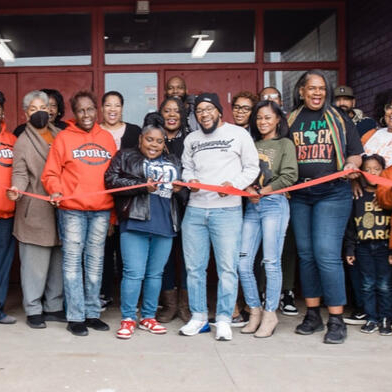
this month I wanted to honor the work of my friend Kristi Williams in Tulsa, Oklahoma. Kristi is the founder of an organization called Black History Saturdays, which aims to supplement the education of black children in her community.
Black history is American history; they’re completely intertwined.
Morgan Freeman
I met Kristi last month when we both traveled to Berlin in January to participate in a Learning Program through an organization called Widen the Circle. Our group of about 15 people visited sites and dove into issues surrounding German remembrance culture. Although we spent a lot of time discussing the Holocaust, the trip felt surprisingly uplifting to me–both because of the remarkable work Germans like Friederike Fechner and Gabriele Hannah are doing of their own accord to honor the victims of the past and because of the great people I met including Kristi.
Kristi’s hometown of Tulsa happens to be the scene of the most devastating White Supremacist terrorist attack in U.S. history AND some of the strictest rules about what teachers can talk about in the classroom. Oklahoma state law HB 1775, approved two years ago, hamstrings teachers when it comes to topics that touch on issues of race or gender, even when pertaining to important historical events. Consequently, teachers have become hesitant to broach subjects, such as the Tulsa Race Massacre, that could lead to conflict with state education officials.
As a direct descendant of survivors of the Tulsa Race Massacre, Kristi felt strongly that kids in her community deserved the opportunity to learn about their own local heritage. So, she began working with educators to develop a curriculum and then hired several experienced teachers. About a year ago, she launched Black History Saturdays to educate local preschool-aged kids through adults about their history and culture on the first Saturday of each month.
Before the program began, Kristi says she agonized over how the logistics of dropping off the kids might work. But once things got started, that was never an issue because all of the adults opted to stay and participate–with everyone starting the day with breakfast together and then dividing into smaller groups according to age. The next few hours are spent learning lessons on topics ranging from politics to the arts before reconvening at lunchtime.
“It’s beautiful to see the whole family there, and the way we designed the curriculum was past, present, future, and so we started with Africa, and then the present and the future is beyond Juneteenth,” Kristi said in a recent interview with PRX. “But what I love about it is that the framework and curriculum is the same for everybody, they’re just learning it at different levels. And so, my goal was that when the family is in the car going to the grocery store, mom or dad can say, what did you learn today? And everybody’s on Africa. So now everyone is learning different things from what everyone has learned in the different age groups.”
To learn more about Kristi and her work, visit her storytelling website with National Geographic or Black History Saturdays.
 Language of Friendship
Thanks for sharing this experience with us. So happy to learn about Kristi’s work in Tulsa.
LikeLike
❤️Heartfelt thanks. You are doing God’s work. Keep it up please & thank Y❤️U again for making a POSITIVE DIFFERENCE in our needy, fragile world. 🙏🏻🕊️❤️
LikeLike