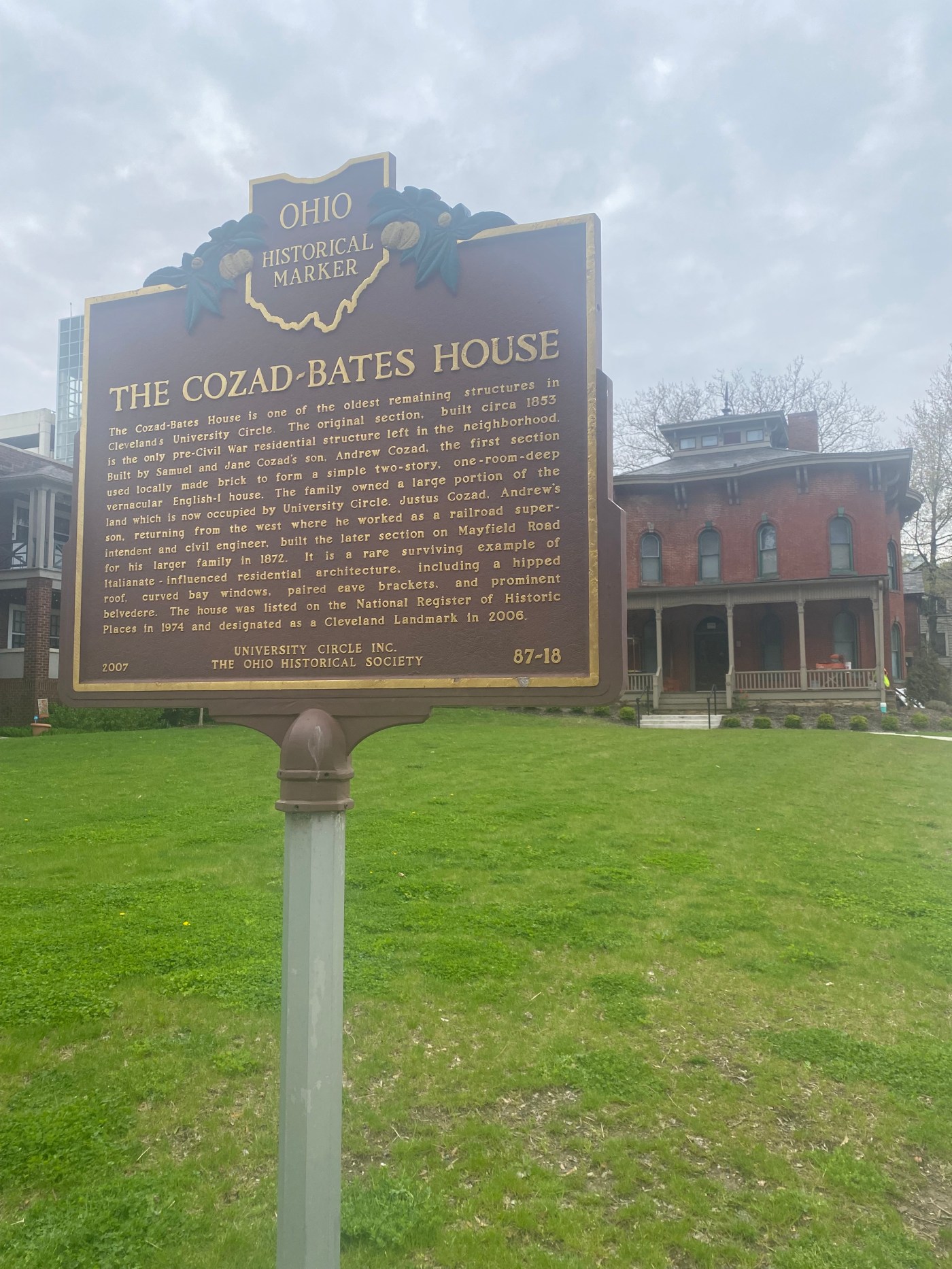
A few years ago, I was visiting my daughter in Cleveland, Ohio, when we noticed a National Historical Landmark sign planted in the sizeable yard in front of a large brick house in this otherwise urban area. We had been exploring the University Heights neighborhood, right near Case Western Reserve University, where she was a student.
We stopped to read the sign and learned we were standing in front of the Cozad-Bates House, which is suspected to have been part of the Underground Railroad that operated from the late 1700s through the Civil War. I think most people know this was not an actual railroad, but rather, a secret system of safehouses, tunnels and paths that abolitionists used to help slaves escape bondage in the Southern United States. After a period of other uses and then neglect, the Cozad-Bates house is now an education center that teaches about Cleveland’s involvement in the Underground Railroad.
Seeing this memorial to the Underground Railroad reminded me of an article I had written decades earlier when I was a student intern at the Huntington Herald-Dispatch in Huntington, West Virginia, back in the early 1990s. A local woman had called the paper to say she suspected her house had been a stop on the Underground Railroad, and the evidence was piling up to solidify her claim. I was assigned the article, and it was one of the most interesting things I wrote about while I was working in Huntington.
This was before the Internet, and I couldn’t find my old hard copy of the article, but I wonder if she ended up learning more and/or finding a way to commemorate the history that had happened there. At the time, I remember the realization dawning on me that although I had learned about the Underground Railroad in school, I was surprised how little was known about this important history that had unfolded right under our feet.
Nowadays, I think there is a greater recognition of the many important but untold stories of history. The Underground Railroad is just one source of these stories, and I hope they continue to be uncovered and recognized.
History, despite its wrenching pain, cannot be unlived, but if faced with courage, need not be lived again.
—Maya Angelou
This February, we challenge our community to learn more about black history. Whether the stories are recently uncovered or long known, our communities are only strengthened through the acknowledgement of our comprehensive and shared American histories.
 Language of Friendship
Leave a comment